

Written By
Tharushi Kawodya
Intern - Frontend
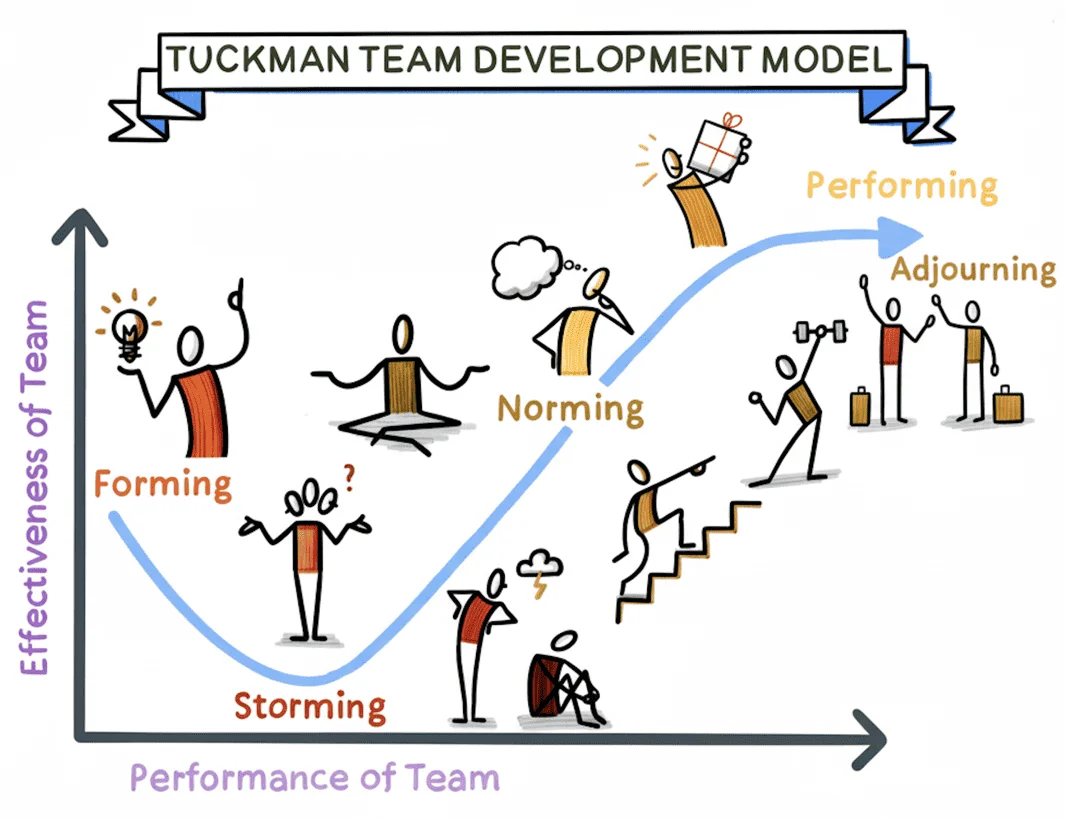
Developed by Bruce Tuckman in 1965, this theory outlines the stages that teams go through, from initial formation to high-performance. By recognizing and navigating these stages, teams can overcome obstacles and achieve their goals more efficiently.
The stages of team development are not just a theoretical concept; they have a significant impact on the success of a project. By understanding and applying Tuckman’s Theory, teams can improve their collaboration, productivity, and overall performance.
- Understanding Tuckman’s Theory can improve team collaboration and productivity.
- Recognizing the stages of team development is crucial for project success.
- Tuckman’s Theory provides a framework for teams to overcome obstacles and achieve their goals.
- Applying Tuckman’s Theory can lead to improved team performance and efficiency.
- Team development stages have a significant impact on project outcomes.
1.Why Team Dynamics Matter More Than You Think
In the realm of project management, team dynamics are often the unsung heroes of success. While tools, methodologies, and plans are crucial, it’s the way team members interact, collaborate, and support each other that ultimately determines project outcomes.
The Human Element Behind Project Success
At the heart of every successful project lies a strong foundation of effective team dynamics. This involves more than just assigning tasks and tracking progress; it’s about creating an environment where team members feel valued, heard, and motivated to collaborate. Collaboration is key to fostering innovation, solving complex problems, and driving projects forward.
- Encouraging open communication
- Fostering a culture of trust
- Promoting mutual respect among team members
When Tools and Methodologies Aren’t Enough
Even with the best tools and methodologies in place, projects can falter if team dynamics are neglected. Tools and methodologies provide the structure, but it’s the human element that brings them to life. For instance, a project management tool can help track progress, but without effective collaboration, team members may work in silos, duplicating efforts or missing critical deadlines.
Some signs that team dynamics are lacking include:
- Poor communication
- Lack of trust among team members
- Conflicting work styles
The Cost of Ignoring Team Development
Ignoring team dynamics can have high costs, including decreased productivity, higher turnover rates, and ultimately, project failure. When team members don’t feel engaged or supported, they’re more likely to disengage, leading to a cascade of negative outcomes. Investing in team development, on the other hand, can yield substantial returns in terms of project success.
| Aspect | Positive Team Dynamics | Negative Team Dynamics |
|---|---|---|
| Productivity | High | Low |
| Turnover Rate | Low | High |
| Project Outcome | Successful | Failed |
2. Understanding Tuckman’s Five Stages of Team Development
In 1965, Bruce Tuckman revolutionized the way we understand team development with his five-stage model. This seminal work has had a lasting impact on project management and team dynamics.
The Origins of Tuckman’s Theory
Bruce Tuckman’s research into team development was groundbreaking because it provided a structured approach to understanding how teams evolve over time. Tuckman’s Theory was developed through observations of various team settings, leading to the identification of five distinct stages that teams typically go through.
The Five Stages at a Glance
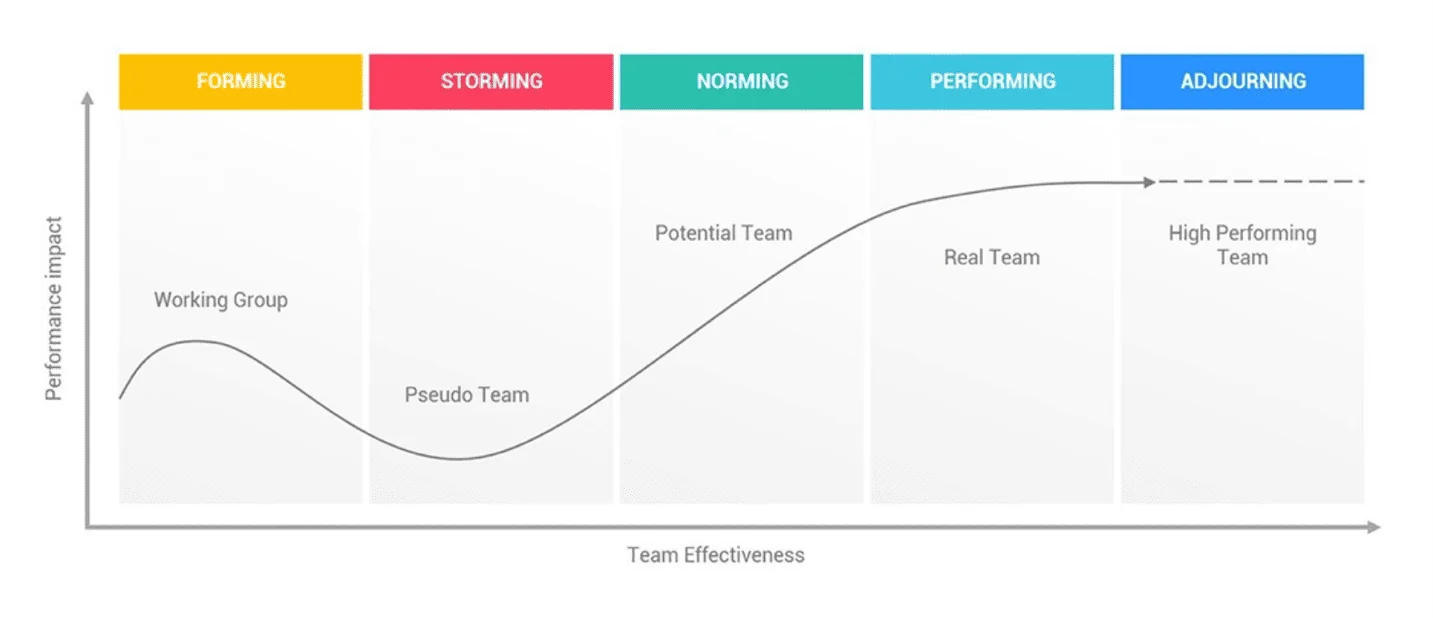
Tuckman’s Five Stages of Team Development are:
- Forming: The initial stage where team members come together.
- Storming: A stage characterized by conflict and competition as team members establish their roles.
- Norming: The stage where the team begins to work together more cohesively.
- Performing: The team reaches a high level of productivity and collaboration.
- Adjourning: The final stage where the team’s task is completed, and members disband. (added later in 1977)
These stages are not only sequential but can also be iterative, as teams may cycle back through earlier stages under certain conditions.
Why This 1965 Model Still Dominates Modern Workplaces
Despite being introduced over five decades ago, Tuckman’s Theory remains highly relevant. Its enduring popularity can be attributed to its simplicity and the universal insights it offers into team dynamics. Modern project management practices continue to benefit from understanding these stages, as they help managers anticipate challenges and opportunities for team growth.
The model’s ability to explain the natural progression of teams makes it a valuable tool for project managers aiming to optimize team performance. By recognizing the stage their team is in, managers can apply appropriate strategies to facilitate progress and achieve project goals.
3. Stage 1: Forming – Setting the Stage for Success
In the initial phase of team development, known as Forming, the groundwork for project success is laid. This stage is characterized by team members getting to know each other and understanding their roles within the project.
Characteristics of the Forming Stage
During the Forming stage, team members often experience uncertainty and dependence on leadership. They look to the project manager for guidance and direction.
- Uncertainty and Dependence on Leadership
Team members may feel uncertain about their roles and responsibilities, leading to a reliance on the project manager to clarify expectations.
- Politeness and Surface-Level Interactions
Interactions among team members tend to be polite and superficial, as individuals are cautious about establishing their positions within the team.
Project Manager’s Critical Role During Forming
The project manager plays a crucial role in setting the tone for the team. By providing clear direction and establishing open communication channels, the project manager can facilitate a smooth transition through the Forming stage.
Actionable Tips for the Forming Stage
To navigate the Forming stage effectively, consider the following strategies:
- Define Roles and Responsibilities From Day One: Clearly outline each team member’s tasks and expectations to avoid confusion.
- Set Clear Expectations and Goals: Establish a shared understanding of the project’s objectives and how they will be achieved.
- Establish Communication Protocols: Determine the most effective channels for team communication to ensure seamless collaboration.
- Create Opportunities for Team Bonding: Organize team-building activities to foster rapport and trust among team members.
Risk and Migration
During the Forming stage, team members may feel unsure about their roles, lack confidence, and communicate only at a basic level, which makes it harder to build trust. This can be improved by clearly explaining everyone’s responsibilities early, encouraging open conversations where people feel safe to ask questions, and arranging kickoff meetings or small team activities. These simple steps help the team feel more connected, boost confidence, and bring everyone together toward the same project goals.
Real-World Example: Software Development Team Kickoff
A software development team embarking on a new project exemplifies the Forming stage. The project manager holds a kickoff meeting to introduce team members, outline roles and responsibilities, and set project goals. By establishing clear expectations and communication protocols, the team is well-prepared to move forward together.
4. Stage 2: Storming – Navigating Conflict and Building Trust
As teams navigate their journey together, they inevitably encounter the Storming stage, a critical phase that tests their resolve and collaboration. This stage is characterized by conflicts, competition, and a struggle for power and control.
Recognizing When Your Team Enters Storming
The Storming stage is marked by several key indicators, including personality clashes and power struggles. Team members may question leadership and processes, leading to tension and conflict.
- Personality Clashes and Power Struggles
As team members with different backgrounds, experiences, and work styles come together, clashes are inevitable. These conflicts can arise from differences in opinion, communication styles, or work habits.
- Questioning Leadership and Processes
During the Storming stage, team members may challenge the leadership and question the processes in place. This is a natural part of the team development process, as members seek to understand their roles and responsibilities.
Why Storming Is Actually Healthy for Teams
While the Storming stage can be challenging, it is a necessary part of team development. By working through conflicts and challenges, teams can build trust, improve communication, and develop a stronger sense of cohesion.
Benefits of the Storming Stage:
- Improved communication and collaboration
- Increased trust among team members
- Clarified roles and responsibilities
- Enhanced problem-solving capabilities
Strategic Approaches to Navigate Storming
To navigate the Storming stage effectively, teams can employ several strategic approaches. These include creating safe spaces for honest communication, addressing conflicts immediately and constructively, reinforcing shared goals and values, and providing coaching and mediation when needed.
- Create Safe Spaces for Honest Communication
Encouraging open and honest communication is crucial during the Storming stage. Team leaders should create a safe and supportive environment where members feel comfortable sharing their concerns and ideas.
- Address Conflicts Immediately and Constructively
Conflicts should be addressed promptly and in a constructive manner. This involves active listening, remaining calm, and focusing on finding solutions rather than placing blame.
| Conflict Resolution Strategies | Description | Benefits |
|---|---|---|
| Active Listening | Listen carefully to the other person’s perspective | Improved understanding, reduced miscommunication |
| Remaining Calm | Manage your emotions to stay focused on the issue | Reduced escalation, more constructive dialogue |
| Solution-Focused | Work together to find a mutually beneficial solution | Increased collaboration, improved outcomes |
- Reinforce Shared Goals and Values
Reminding team members of their shared goals and values can help to refocus their efforts and reduce conflict. This involves clearly communicating the team’s purpose and objectives.
- Provide Coaching and Mediation When Needed
In some cases, conflicts may require external intervention. Team leaders should be prepared to provide coaching or mediation to help resolve disputes and improve team dynamics.
Risks and Mitigation
During the Storming stage, team members may disagree, clash over ideas, or question decisions, which can slow progress and create tension. These issues can be reduced by encouraging honest but respectful communication, solving problems early instead of ignoring them, and reminding everyone of the shared project goals. When team members feel heard and supported, conflicts turn into learning moments and trust slowly starts to grow.
Case Study: Marketing Campaign Team in Crisis
A marketing campaign team faced significant challenges during the Storming stage. With team members having different opinions on the campaign direction, conflicts arose, and progress was hindered. By implementing the strategic approaches outlined above, the team was able to navigate this stage successfully, ultimately delivering a highly successful campaign.
5. Stage 3: Norming – Establishing Team Cohesion
After weathering the storm, teams enter the Norming Stage, a period characterized by growing trust and cooperation. At this juncture, team members begin to understand each other’s strengths and weaknesses, leading to more effective collaboration.
Signs Your Team Has Reached the Norming Stage
During the Norming Stage, several key indicators signal that your team is on the right track. These include:
- Mutual Respect and Trust
Team members develop a deeper understanding of each other, fostering an environment of mutual respect and trust. This foundation is crucial for open communication and collaborative problem-solving.
- Established Working Rhythms
The team settles into established working rhythms, with members becoming more comfortable with their roles and responsibilities. This stability enhances productivity and efficiency.
Leveraging the Norming Phase for Long-Term Success
To maximize the benefits of the Norming Stage, project managers should focus on strategies that promote continued cohesion and improvement.
Project Management Strategies During Norming
Effective project management during this stage involves several key strategies:
- Encourage Collaborative Problem-Solving
Foster an environment where team members feel encouraged to collaborate on challenges. This can be achieved through workshops, brainstorming sessions, and cross-functional projects.
- Document and Standardize Team Processes
As the team settles into its rhythm, it’s essential to document and standardize processes. This not only improves efficiency but also helps in onboarding new team members.
- Celebrate Progress and Acknowledge Contributions
Recognizing and celebrating the team’s progress and individual contributions boosts morale and reinforces positive behaviors.
- Foster Continuous Improvement Mindset
Encourage the team to embrace a continuous improvement mindset. This involves regularly reviewing processes, seeking feedback, and implementing changes as needed.
| Strategy | Description | Benefits |
|---|---|---|
| Collaborative Problem-Solving | Workshops and cross-functional projects | Improved efficiency, easier onboarding |
| Standardizing Processes | Documentation of workflows | Improved efficiency, easier onboarding |
| Celebrating Progress | Recognition of achievements | Boosted morale, reinforced positive behaviors |
Risks and Mitigation
In the Norming stage, teams may become too comfortable and stop improving, or avoid raising issues just to keep peace. This can be handled by encouraging regular feedback, reviewing work processes, and motivating the team to keep learning and improving. Celebrating small wins also helps maintain energy while ensuring the team continues moving forward together.
Example: Construction Project Team Finding Its Groove
A construction project team, after navigating the initial conflicts, entered the Norming Stage. By implementing regular feedback loops and standardizing their workflow, they were able to complete the project 15% ahead of schedule.
6. Stage 4: Performing – Reaching Peak Productivity
Reaching the Performing stage is a significant milestone in team development, marking a period where teams achieve peak productivity and work together seamlessly.
What High-Performing Teams Look Like in Action
High-performing teams exhibit certain characteristics that enable them to deliver exceptional results. Two key traits of such teams are:
- Autonomous Decision-Making
Teams in the Performing stage are characterized by their ability to make decisions autonomously. This autonomy fosters a sense of ownership and accountability among team members, leading to more efficient and effective decision-making processes.
- Seamless Collaboration Without Constant Oversight
Members of high-performing teams collaborate effortlessly, having established a strong foundation of trust and understanding during the previous stages. This enables them to work together smoothly without needing constant supervision.
Sustaining Momentum During the Performing Stage
To maintain the momentum achieved during the Performing stage, it’s crucial to implement strategies that support continued high performance. This includes recognizing achievements and providing constructive feedback to team members.
Leadership Shifts for Maximum Performance
Leaders play a critical role in maximizing team performance during the Performing stage. Key leadership shifts include:
- Delegate Greater Autonomy and Ownership
Leaders should continue to delegate more responsibilities to team members, fostering a sense of ownership and encouraging them to take initiative.
- Focus on Removing Roadblocks Rather Than Directing
Instead of directing every aspect of the team’s work, leaders should focus on identifying and removing obstacles that could hinder progress.
- Maintain Recognition and Constructive Feedback
Regular recognition of achievements and constructive feedback are essential for maintaining high morale and guiding the team towards continued improvement.
- Challenge the Team with Stretch Goals
Setting challenging yet achievable goals helps to keep the team motivated and engaged, pushing them to strive for even better performance.
Risks and Mitigation
At the Performing stage, teams work at a high level, but there is a risk of burnout due to heavy workloads or mistakes caused by overconfidence. These risks can be minimized by balancing tasks, checking in regularly on team well-being, and continuing to provide feedback and appreciation. Supporting the team while challenging them with achievable goals helps maintain strong performance without exhaustion.
Real Example: Product Launch Team Exceeding Expectations
A software development company formed a team to launch a new product. By the time they reached the Performing stage, they were working cohesively, making autonomous decisions, and collaborating seamlessly. The leadership focused on removing roadblocks and providing feedback, resulting in the team exceeding their launch targets by 20%.
| Characteristics | Leadership Strategies | Outcomes |
|---|---|---|
| Autonomous Decision-Making | Delegate Greater Autonomy | Increased Efficiency |
| Seamless Collaboration | Remove Roadblocks | Improved Productivity |
7. Stage 5: Adjourning – Closing Projects with Purpose
As projects come to a close, teams enter the Adjourning Stage, a critical phase often overlooked. This final stage in Tuckman’s model is crucial for wrapping up projects effectively, ensuring that team members are supported through the transition, and capturing valuable lessons learned.
Understanding the Emotional Dynamics of Project Closure
Project closure is not just about completing tasks; it’s also about managing the emotional aspects of wrapping up a project. Team members often experience a mix of emotions, from relief to sadness, as they conclude their work together. Acknowledging these feelings is essential for maintaining a positive team culture.
Essential Practices for the Adjourning Stage
To navigate the Adjourning Stage successfully, several key practices should be implemented:
- Conduct Comprehensive Project Retrospectives
A thorough retrospective analysis helps identify what went well and what didn’t, providing valuable insights for future projects. This process involves the entire team and encourages open discussion about the project’s successes and challenges.
- Celebrate Team Achievements Meaningfully
Celebrating the team’s achievements is crucial for boosting morale and reinforcing a sense of accomplishment. This can be done through various means, such as team lunches, awards, or written recognition.
- Provide Clear Closure and Future Direction
Clear communication about the project’s closure and future directions helps team members understand their next steps. This includes providing information about new projects or roles within the organization.
- Document Lessons Learned for Future Teams
Documenting lessons learned is vital for organizational knowledge management. This documentation should be accessible to future teams, helping them avoid similar pitfalls and replicate successful strategies.
| Practice | Description | Benefits |
|---|---|---|
| Comprehensive Project Retrospectives | In-depth analysis of project successes and challenges | Improved future project planning, enhanced team learning |
| Meaningful Celebrations | Recognition of team achievements | Boosted morale, reinforced sense of accomplishment |
| Clear Closure and Future Direction | Communication about project closure and next steps | Reduced uncertainty, facilitated transition |
| Documentation of Lessons Learned | Recording of project insights for future reference | Organizational knowledge management, improved future projects |
Risks and Mitigation
During the Adjourning stage, team members may feel sad or uncertain as the project ends, and valuable lessons might be forgotten. This can be avoided by celebrating achievements, holding a final review to discuss what was learned, and clearly explaining next steps. Taking time to reflect and recognize everyone’s efforts helps close the project positively and prepares the team for future work.
Supporting Team Members Through Transition
As team members transition out of the project, it’s essential to provide support. This can include outplacement services, career counseling, or simply being available to answer questions. Effective transition support helps maintain a positive relationship with former team members and enhances the organization’s reputation.
By focusing on the Adjourning Stage and implementing these practices, organizations can ensure that projects are closed with purpose, and team members are well-supported through the transition.
8. Applying Tuckman’s Model to Modern Project Management Practices
As project management continues to evolve, Tuckman’s Model remains a cornerstone for understanding team dynamics. The model’s enduring relevance is a testament to its foundational insights into the stages of team development. In this section, we will explore how Tuckman’s Model is applied in modern project management practices, including its adaptation to remote and hybrid work environments, integration with Agile methodologies, and consideration of cultural factors in diverse teams.
Adapting Team Stages for Remote and Hybrid Work Environments
The shift to remote and hybrid work environments has presented new challenges for team development. According to a study by McKinsey, “remote work has increased by 50% since the onset of the pandemic, highlighting the need for project managers to adapt Tuckman’s Model to these new environments.” To effectively apply Tuckman’s Model in remote settings, project managers must be proactive in fostering communication, trust, and collaboration among team members.
One strategy is to use digital tools to facilitate regular check-ins and feedback loops, ensuring that team members feel connected and engaged throughout the project lifecycle. For instance, tools like Slack and Trello can be used to create virtual spaces for team collaboration and communication.
Integrating Tuckman’s Theory with Agile Methodologies
Agile methodologies have become increasingly popular in project management, emphasizing flexibility, iterative progress, and continuous improvement. Integrating Tuckman’s Theory with Agile methodologies can enhance team performance by aligning team development stages with Agile principles.
For example, during the Storming stage, Agile practices such as daily stand-ups and retrospectives can help teams navigate conflicts and improve collaboration. As
“Agile is not just a methodology, it’s a mindset that fosters a culture of continuous improvement and teamwork,” notes a leading Agile coach.
Building Team Development into Project Timelines
Effective project management involves not only planning project tasks but also considering the developmental needs of the team. By incorporating Tuckman’s Model into project timelines, project managers can allocate time and resources for team building and development activities.
- Identify key milestones where team development stages are likely to occur.
- Allocate resources for team-building activities during the Forming and Norming stages.
- Use the Performing stage to maximize productivity and project outcomes.
To effectively evaluate these development efforts, project managers can rely on Key Performance Indicators (KPIs) to measure both team progress and project outcomes.
When applying the team development stages proposed by Bruce Tuckman to modern project management, several KPIs can be used to track both team health and project success. Common measurements include task completion rate (percentage of completed tasks versus planned tasks), velocity or productivity (amount of work delivered in a given time), communication effectiveness (response times and meeting participation), and defect or rework rate (how often work needs fixing). Teams can also monitor employee engagement through short surveys, adherence to deadlines, and customer or stakeholder satisfaction scores. Together, these KPIs help project managers understand how well the team is performing, identify bottlenecks early, and adjust leadership strategies to improve collaboration and outcomes.
Digital Tools That Support Each Development Stage
The right digital tools can significantly support team development across Tuckman’s stages. For instance, during the Forming stage, tools like Asana can help clarify roles and responsibilities, while during the Storming stage, tools like Mural can facilitate collaborative problem-solving.
| Tuckman’s Stage | Digital Tool | Purpose |
|---|---|---|
| Forming | Asana | Clarify roles and responsibilities |
| Storming | Mural | Facilitate collaborative problem-solving |
| Norming | Slack | Enhance team communication |
Cultural Considerations for Diverse Teams
In today’s globalized work environment, project teams are often culturally diverse. Applying Tuckman’s Model to diverse teams requires consideration of cultural factors that can influence team dynamics. Project managers should be sensitive to these cultural differences and adapt their leadership style accordingly.
As Geert Hofstede, a renowned expert on cultural differences, notes, “cultural intelligence is crucial for effective leadership in multicultural teams.” By understanding and respecting cultural differences, project managers can foster a more inclusive and collaborative team environment.
9. Common Team Development Pitfalls (And How to Fix Them When You’re Stuck)
Teamwork sounds simple… until you’re in the middle of it. Tuckman’s model Forming → Storming → Norming → Performing gives a roadmap, but real life throws curveballs. Here’s what it feels like inside the chaos and how to fix it
· “We’re Just Meeting… Now What?” (Rushing Forming)
You’ve just formed the team. People nod politely in introductions, but no one really knows what they’re supposed to do. Tasks overlap. Miscommunication starts creeping in.
Fix in the Moment: Stop and slow down. Clearly introduce everyone, define roles, and set concrete goals. Even a short alignment meeting can save hours of confusion later.
- “Ugh… Conflict Again?” (Avoiding Storming)
Someone disagrees on how to approach a task. Tension rises, and you’re tempted to sweep it under the rug. But the frustration lingers and communication breaks down.
Fix in the Moment: Encourage people to speak up safely. Ask questions like, “What’s your concern?” or “How do you see it differently?” Confronting small conflicts now prevents bigger explosions later.
- Wait… Didn’t We Fix This?” (Ignoring Regression)
A new member joins or the project scope changes, and suddenly old problems resurface. People are confused again. Productivity drops.
Fix in the Moment: Spot the regression early. Check in with the team individually and in groups. Clarify expectations, revisit roles if needed, and get everyone back in sync.
- “We Have a Deadline… Forget Everyone Else!” (Prioritizing Deliverables Over Team Health)
Everyone is working late. Energy is low. People start burning out, mistakes increase, and motivation tanks.
Fix in the Moment: Take a breather. Reassess workloads, encourage breaks, and show that you value people, not just deliverables. Small gestures like a quick team check-in or celebrating small wins boost morale instantly.
- “I’m the Boss… But Nothing’s Moving” (Sticking to One Leadership Style)
You keep giving instructions, but the team feels stuck. Or maybe you’re hands-off, and everyone’s confused. Your leadership style doesn’t match the team’s stage.
Fix in the Moment: Adapt. Be clear and directive in the early stages, then step back and collaborate more as the team grows. Ask yourself: “What does my team need from me right now?” Adjusting gears keeps everyone moving.
10. Conclusion
Understanding Tuckman’s Team Development Theory isn’t just textbook knowledge, it’s a practical compass for leading teams in real projects. When you can identify whether your team is forming, storming, norming, performing, or preparing to adjourn, you’re no longer guessing… you’re guiding.
Each stage presents both challenges and opportunities, and knowing what to look for allows you to tailor your leadership approach to match your team’s needs. Strong leadership decisions like encouraging open conflict for deeper trust or balancing deadlines with team well‑being come from understanding the journey your team is on.
In today’s fast‑paced workplaces, whether remote, hybrid, or in‑office, applying models like Tuckman’s can be a game‑changer. It helps teams adapt, grow faster, resolve conflicts constructively, and reach high performance more consistently. Research in 2024 and 2025 continues to demonstrate how team dynamics and leadership clarity at each stage directly impact collaboration and outcomes. (RSIS International)
If you want to explore more, check out these authoritative resources:
- Tuckman’s Team Development Model Guide (Open University) – A concise explanation of the original stages and team behaviours. (The Open University)
- In‑Depth Look at Tuckman’s Five Stages – A deeper dive into the characteristics and leadership needs at each phase. (eCampus Ontario Pressbooks)
By integrating Tuckman’s model into your project management habits and combining it with tools like situational leadership and team communication frameworks, you’ll not only manage teams, you’ll develop them. And that’s what transforms good teams into high‑performing ones.